
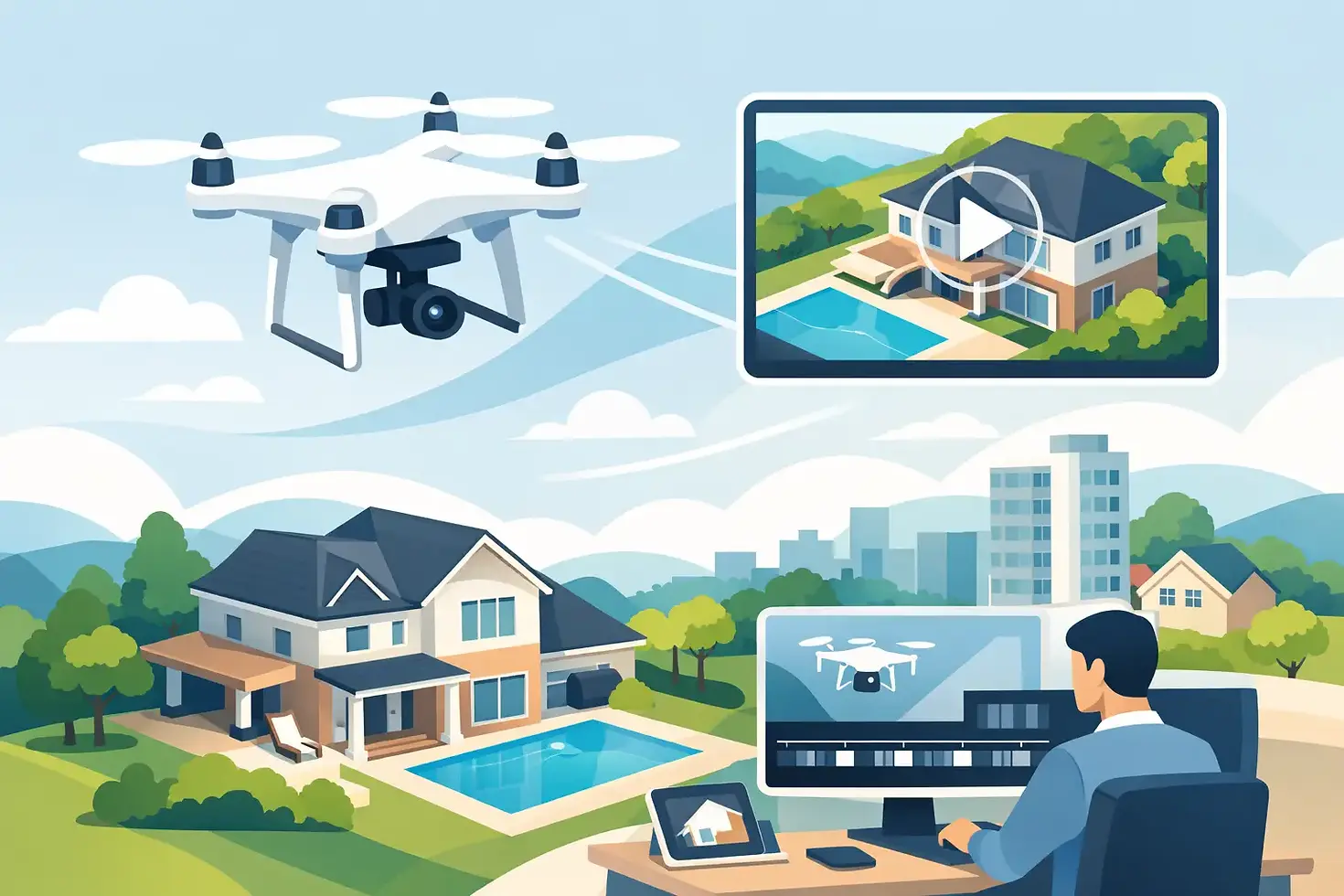
Drone Video for Property Listings That Sells
A buyer can forgive a dim hallway photo. They rarely forgive confusion. If they cannot tell how the house sits on the lot, how close the neighbors are, or what the backyard actually looks like, they move on. That is where drone video for property listings earns its place - not as a gimmick, but as a clear way to remove uncertainty and help serious buyers understand the property faster.
For agents, brokers, developers, and property owners, that clarity matters. Every showing, every inquiry, and every day on market carries a cost. Strong aerial video helps a listing present the full picture at the start, which can improve buyer interest and filter out people who were never a fit in the first place.
Why drone video for property listings works
Standard ground photography does one job very well. It shows finishes, lighting, room condition, and interior style. What it cannot do as effectively is explain context. Buyers want to know how the driveway approaches the home, whether the lot feels private, how the outdoor living areas connect, and what surrounds the property.
A well-planned drone video answers those questions in seconds. It shows the home in relation to the street, neighboring properties, tree lines, ponds, acreage, shared amenities, and nearby commercial or recreational features. That wider perspective can be especially valuable for larger homes, rural properties, new developments, lake homes, and commercial real estate.
There is also a practical trust factor. When a listing includes clean, stable aerial footage, it signals preparation and professionalism. Buyers may not think in aviation terms, but they do recognize when marketing is done with care. That perception can lift the credibility of the listing and of the agent behind it.
What buyers actually want to see
The best aerial video is not just a series of high-altitude flyovers. Buyers are not watching to admire camera movement alone. They are trying to answer a simple question: can I picture myself here, and does this property fit my needs?
That means the footage should serve the property. On a suburban home, that may mean showing the front elevation, lot shape, backyard depth, fence line, and proximity to parks or schools. On a rural parcel, it may mean tracing the driveway approach, boundary feel, outbuildings, water features, and access points. On a commercial listing, buyers may care more about parking, traffic flow, loading areas, nearby roads, and site visibility.
The strongest videos balance emotion with information. They create interest, but they also orient the viewer. If the footage is beautiful but leaves basic questions unanswered, it has done only half the job.
The value of location context
Location is one of the biggest reasons aerial video performs well in real estate marketing. A house does not exist in isolation. Buyers assess neighborhoods, surrounding land use, distance to key roads, and how the property sits within the community.
This is where a disciplined operator makes a difference. It is easy to capture random overhead shots. It takes planning to frame a property so the viewer understands what matters without misrepresenting distance, lot size, or surroundings. Good drone work should make the listing clearer, not more dramatic than reality.
When aerial video makes the biggest impact
Not every listing needs a full cinematic package. That is part of being practical about marketing spend. For some entry-level homes in dense neighborhoods, professional still photography may carry most of the load. For other properties, drone video is one of the highest-value assets in the marketing package.
It tends to have the strongest impact when the property has land, views, exterior upgrades, unusual layout, premium surroundings, or access features that are hard to appreciate from the ground. Corner lots, golf course homes, waterfront properties, equestrian sites, farms, commercial buildings, and development tracts all benefit from aerial perspective.
Luxury listings are the obvious fit, but they are not the only fit. Mid-market properties with strong outdoor living spaces often perform better when buyers can see the pool, patio, tree cover, and yard flow in one continuous sequence. New construction also benefits because aerial video helps show lot placement and neighborhood progress.
Cases where less is more
There are trade-offs. If a property sits too close to neighboring homes, aerial footage can highlight limitations as much as benefits. If the exterior is unfinished or the surrounding lots are under heavy construction, timing matters. In some cases, waiting a few weeks produces a stronger result.
The point is not to force drone footage into every listing. The point is to use it where it improves decision-making and supports the sale.
What separates professional drone video from cheap footage
A smartphone clip from a hobby pilot may get airborne, but that does not mean it supports a high-value listing. Real estate marketing requires more than flying a drone over a roofline.
Professional drone video starts with planning. The operator needs to understand the property, the selling points, the local environment, the lighting window, and the intended audience. Flight paths should be purposeful. Movements should be stable and measured. Transitions should support the story of the property rather than distract from it.
Safety and compliance matter just as much as image quality. Real estate agents and property owners should not have to guess whether the pilot is licensed, insured, or operating within regulations. A professional provider handles airspace awareness, site assessment, and operational discipline as part of the job.
Editing is another dividing line. Raw aerial clips rarely perform well on their own. A finished property video should be paced to hold attention, trimmed to the strongest angles, and organized so the viewer understands the home from approach to overview. Clean color, steady framing, and a logical sequence do more for a listing than flashy effects ever will.
How to plan drone video for property listings
If you want useful footage, start with the property strategy. What is the home competing on? Space, privacy, amenities, architecture, location, commercial access, or development potential? The answer should shape the shoot.
It also helps to think about season, time of day, and property readiness. Fresh landscaping, clean driveways, staged outdoor furniture, and clear pool water all show up from the air. So do patchy lawns, clutter, open garage doors, and neglected rooflines. Aerial video is honest in a way some ground angles are not.
The best results usually come from coordination between the listing agent, property owner, and drone operator. Walk through the priorities in advance. Identify any features that must be shown, any neighboring elements that should be minimized, and any access or privacy concerns that need to be respected.
Questions worth asking before the shoot
Ask what deliverables you will receive and where they can be used. A full listing video, short social clips, vertical edits, and still frame grabs may all have value, but not every property needs every format. Ask how weather delays are handled and whether the operator can advise on ideal timing.
Most important, ask how the provider balances visual quality with compliance and safety. That answer tells you a lot about how the rest of the project will be handled.
Why credibility matters as much as creativity
Real estate moves quickly, but that does not mean aerial work should be improvised. If a drone team shows up without process, the risk is not only weak footage. It can also mean delays, reshoots, neighborhood complaints, or avoidable operational issues.
That is why many real estate professionals prefer a provider with a disciplined background and a clear service mindset. At Gods Eye Drone, that standard comes from veteran-led professionalism, certified flight operations, and a focus on practical results rather than empty spectacle. For listing clients, that means the aerial media is created with the same attention to accountability, planning, and execution that serious projects demand.
Buyers notice strong presentation. Sellers notice when their property is marketed with intention. And agents notice when a vendor delivers what was promised without creating extra work.
Drone video is not about hype
At its best, drone video does one thing very well. It helps people understand a property before they ever step on site. That can increase interest, improve lead quality, and give a listing a stronger first impression in a crowded market.
The key is to treat aerial video as a decision tool, not decoration. When the footage is accurate, polished, and built around the real strengths of the property, it becomes more than marketing. It becomes part of the selling process.
If a listing has something worth seeing from the air, show it with precision. Buyers are already making fast judgments. Give them a reason to keep looking.


Comments